Skip to content
LUMING洛铭BIOMEDICAL DATA SCIENCE CONSULTING

BIOMEDICAL DATA SCIENCE CONSULTING

From multi-omics data to R&D decisions you can verify.

Oncology bioinformatics, statistical modeling and translational research. We work as an external data science department for your R&D team: you bring the research question, we deliver figures and conclusions ready for the decision meeting and the data room.

  • China · Europe · Taiwan
  • Discovery → Validation → Translation
  • Multi-omics × Statistical modeling × Machine learning
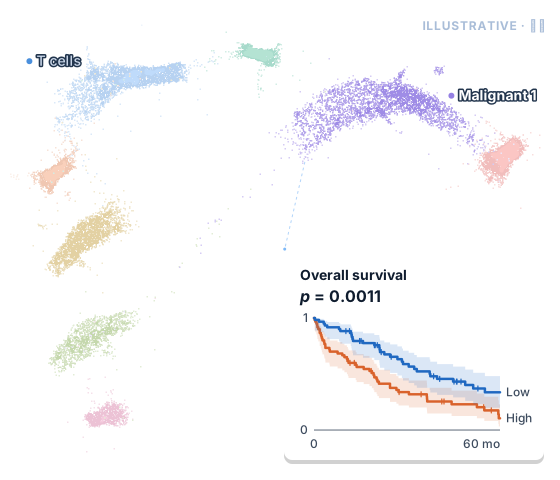
Illustrative composite: a single-cell UMAP point cloud overlaid with a Kaplan–Meier survival card for high- and low-risk groups, representing the path from multi-omics data to a verifiable conclusion. Synthetic data.
ILLUSTRATIVE · Not real client data

WHO WE WORK WITH

Who we work with

  • Biotech and pharma:target assessment, indication selection, project initiation and business development materials.
  • CROs:bioinformatics and statistical modeling within your projects.
  • Hospitals and research groups:clinical sample data analysis, predictive models, manuscript support.

THE PROBLEMS WE SOLVE

Where we help

You have candidate targets, but no clear indication

You need to decide which target to advance first, or which indication to pursue next. We use public data from TCGA, ICGC, GEO and CCLE to show where a target is overexpressed in tumor versus normal tissue, where the normal-tissue safety window lies, and how expression relates to immune infiltration and prognosis. You don't need to share any internal data for this.

You have the data, but not the answer

Your scRNA-seq, bulk RNA-seq, WES or ctDNA data is waiting for analysis, or your bulk results are ambiguous because averaging across a whole tissue dilutes the signal. We integrate multi-omics data and analyze it at single-cell resolution. QC report first, then cell annotation, cluster maps and sample-level results.

Your conclusions have to survive scrutiny

Project reviews, licensing partners and journal reviewers all ask the same question: where does this number come from? Our statistical and predictive models are cross-validated and externally validated. Every number traces back to its source, and the code ships with the report.

CORE CAPABILITIES

Four services

01

Public data mining for target and indication discovery

Pan-cancer expression specificity, pathways, signatures and immune infiltration from TCGA, ICGC, GEO and CCLE. Hi-C / HiChIP 3D genomics to link non-coding GWAS variants to the genes they actually regulate.

Deliverablestarget/indication evidence pack, publication-grade figures, reproducible scripts

Illustrative box plot of a target's expression in tumor versus normal tissue across 12 TCGA cancer types (BRCA, LUAD, LIHC, COAD, PAAD, KIRC, STAD, HNSC, OV, PRAD, SKCM, GBM); expression is higher in tumor for most types. Synthetic data.

02

Single-cell and multi-omics integration

scRNA-seq, bulk RNA-seq, WES and ctDNA. Genome, transcriptome and proteome data integrated around the tumor microenvironment.

Deliverablescell annotation and cluster atlas, sample-level results tables, QC report

Illustrative single-cell UMAP of more than 10,000 cells in eight clusters: T cells, NK cells, B cells, myeloid cells, fibroblasts, endothelial cells and two malignant clusters. Synthetic data.

03

Statistical analysis and predictive modeling

Survival analysis, logistic regression, GEE, GLM/Lasso; Random Forest, SVM and other machine learning methods, with cross-validation and external validation.

Deliverablesstatistical analysis plan, model code and validation, nomogram or risk stratification tool

Illustrative forest plot of hazard ratios with 95% confidence intervals for age, stage, mutation status and performance status, with a reference line at HR = 1. Values are illustrative.

04

Preclinical and translational research support

Biomarkers, clinical sample data and antibody drug strategy. Design and interpretation of in vivo and in vitro studies.

Deliverablestarget assessment report, study protocol and sample size, manuscript support

Illustrative heatmap of 24 genes across 60 samples grouped by risk, beside Kaplan–Meier survival curves showing poorer survival in the high-risk group, with the log-rank p-value shown. Synthetic data.

PRODUCT · EVIDENCE PACK

Target–Indication Evidence Pack

A standard-format report on a single target that answers one question: in which indication does this target have a case, and where are the risks? Built for licensing discussions, project initiation and indication selection.

  • Starts with zero client data. Everything comes from public databases. We don't need your sequences, experimental data or your clients' data.
  • 8–12 pages per target, with reproducible scripts. Covers pan-cancer expression specificity, normal-tissue safety window, immune infiltration, co-expression and pathway signatures, prognostic association, cell-type localization at single-cell level, and a scan of clinical trials and competing programs.
  • Delivered in about 4–6 weeks, depending on scope.
  • Pilot starts at 3 targets. Once format and methods are set, it extends to larger target sets.

Evidence Pack fixed layout

Three report-page thumbnails: expression, single-cell, survival; each pack runs 8–12 pages.

Illustrative layout of the Target–Indication Evidence Pack: three report page thumbnails with an expression box plot, a single-cell map and survival curves; each pack runs 8–12 pages.
ILLUSTRATIVE · Not real client data

WORKFLOW

How a project runs

Our approach
  1. 01

    Define the question:

    turn the R&D question into a testable hypothesis.

  2. 02

    Assess the data:

    AI-assisted scans of literature and databases; an expert decides whether the data can answer the question.

  3. 03

    Analyze and validate:

    reproducible pipelines, every number traceable to its source.

  4. 04

    Interpret the biology:

    map results back to mechanism and clinical context.

  5. 05

    Deliver for decisions:

    figures and conclusions ready for the meeting room and the data room.

HOW WE WORK

AI speeds us up. Experts check the work. Everything is reproducible.

We use AI every day: LLMs and agents help scan literature and clinical trial databases, generate code and draft reports. A computational biologist checks every number, and every conclusion traces back to its source.

AI we don't do

  • No black-box predictions. If we can't explain why a model works, we don't deliver it.
  • No promises that "AI will find your target."
  • Client data never goes into public models.

SELECTED COLLABORATION

Selected publications

All publications

Other co-authored work

BMC Medicine2021

a nomogram for combination-therapy benefit in EGFR-mutant NSCLC

Advanced Science2020

dynamic ctDNA neoantigen monitoring, with molecular response detected before imaging response

DATA SECURITY

Four commitments on your data

  • Your data stays on your servers. We work through remote access.

  • Confidential from day one. NDA signed before kickoff; everyone on the project is bound by it.

  • Returned or destroyed. All copies are returned or destroyed at project close, as agreed.

  • Compliance first. We follow human genetic resources and data security regulations. Client data never goes into public models.

Put your data to work in real R&D decisions

Start with a free 30-minute consultation. Walk us through your question. We'll tell you whether we can answer it, how, and what data it takes. If we can't, we'll say so.

NMDD919@gmail.com